THE STORY OF BENTONVILLE STATION: RISE & FALL OF AN HISTORIC RAIL STATION: BENTONVILLE 1882 TO 1971
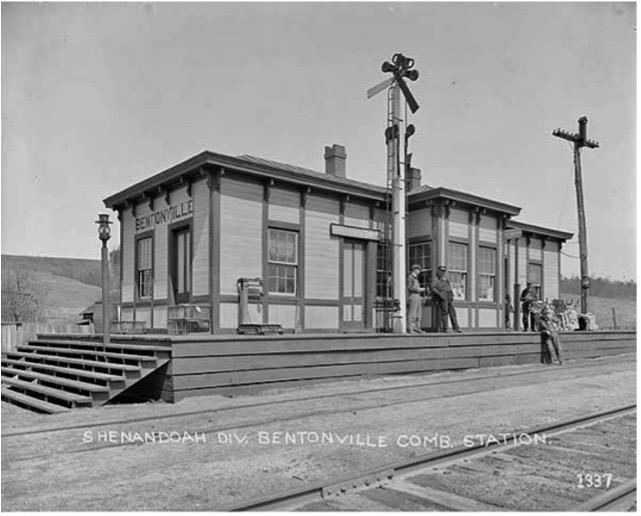
This photo shows the Bentonville Railroad Station in 1917 when an excursion roundtrip to Washington DC, cost only $2.50. It was taken 37 years after the first train pulled into Bentonville. 1882 to 1923 was a golden age for Warren and Page County residents who wanted to visit nearby towns by train, rather than by foot, horseback, or carriage. Those who wanted to travel further could board a train in Bentonville and be in Washington DC. or Baltimore the same day. The building in this photo is most likely the first station built at Bentonville but it would be replaced later by at least two more buildings before the station was finally closed and demolished in the 1970s.
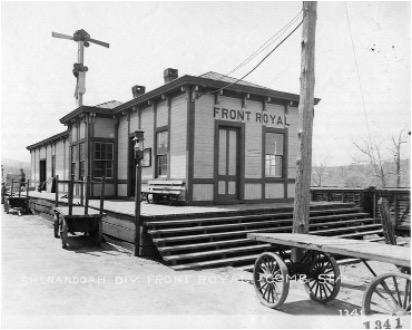
The design of this early building appears to be identical to that of the Front Royal rail station of approximately the same date (see photo on left).
It was not uncommon to move station buildings to accommodate a new track realignment or, if a new larger building was required, the existing structure might be loaded on a flat car and transported by rail to a new location.
THE 1880s & 1890s: RAIL TRANSFORMS TRAVEL & TRANSPORT IN THE VALLEY
Before the first railroads arrived, the gundalows/barges that navigated the Shenandoah River, singly or in fleets, were often the only way to move heavy goods such as flour, timber, iron, tanbark, and coal to Harpers Ferry – where they would be offloaded onto canal barges and transported to tidewater markets at Georgetown and Alexandria. After the first rail connection between Riverton and Alexandria was established the gundalows would offload their cargoes in Riverton, rather than having to navigate the Potomac River all the way to Harpers Ferry. The arrival of the Shenandoah Valley Railroad in the 1880s finally brought an end to most commercial navigation on the river. According to an article in the Page Courier written by Gabriel in May, 1900, “the last three boats that ever went down the river were built about eleven years ago” (i.e. in about 1889).
The building of the Shenandoah Valley Railroad was welcomed by almost everyone in the Shenandoah Valley. However, the speed at which it was built required the hiring of large numbers of men who were expected to work day and night under difficult conditions to ensure that deadlines were met. In May, 1880 125 colored (Black) railroad laborers went on strike in Warren County demanding that their regular pay be increased from $1:00 to $1:59 per hour. The railroad contractors met this resistance by appealing to the local sheriff, Sheriff Rust, who raised a posse of 25 men armed with carbines, muskets, rifles, and shotguns to preserve the peace and provide an escort for 60 regular laborers brought in to replace the striking workers. This succeeded in bringing the strike to an end in a relatively short period of time.
Later in 1880 the SVRR finally reached Bentonville, although stage coaches were required to travel any further. By 1881 the track ran all the way to Luray. The railroad was eventually completed in June, 1882. It extended through the Shenandoah Valley from Hagerstown, Maryland, through West Virginia’s eastern panhandle, into Virginia to reach Roanoke, and connected with the Norfolk & Western (N&W) Railroad. It also provided access north of the Potomac River, reaching as far as Harrisburg, and Pennsylvania. Goods of all kinds could now be shipped by rail to New York, Baltimore, Philadelphia, Washington D.C and the ports of Georgetown, Alexandria and Norfolk. Many of these trains also carried passengers. In December, 1890 the SVRR was acquired and absorbed by the N & W Railroad.
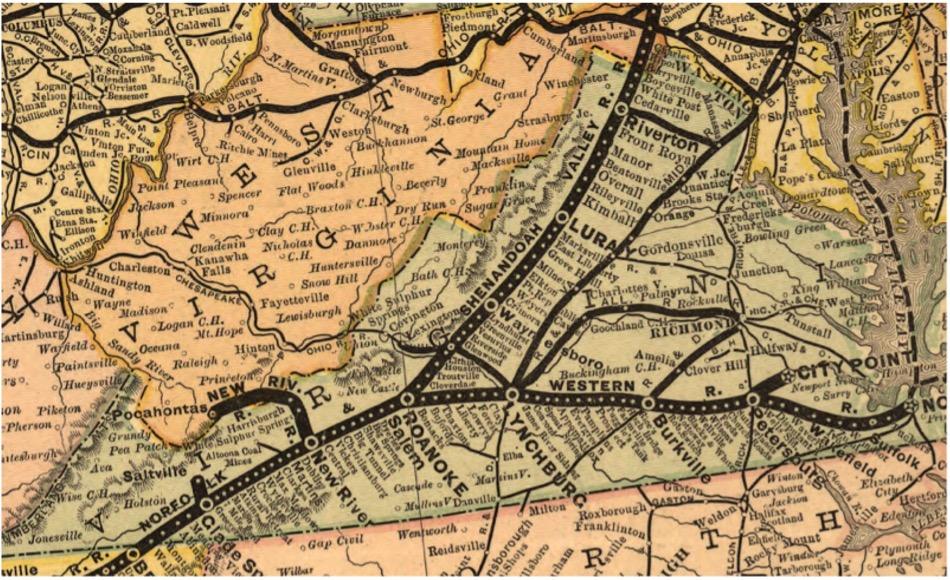
The map on the left shows the railroad network in the Shenandoah in 1882. Amazingly, there were five railroad stations located between Front Royal and Luray, two of which were in Warren County. The Manor Station was located just north of Bentonville and would later be renamed Limeton. Sometime later another small station opened at Karo.
The post-bellum years were a boom time for Warren County as soldiers returned from the war and set about rebuilding destroyed infrastructure, and farmers were able to find new markets for their produce and livestock. The arrival of the Shenandoah Valley Railroad (SVRR) made Bentonville a very attractive commercial/shipping location for small businesses, farmers and leather tanneries.
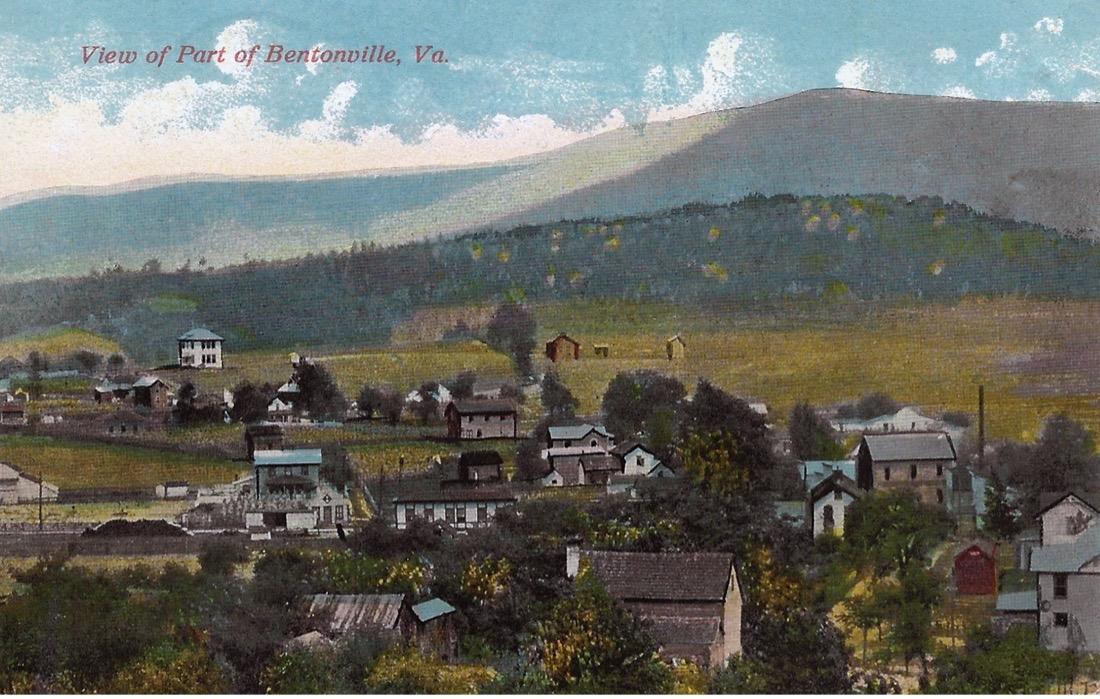
An 1884 newspaper article concluded that Bentonville had a bright future, and that “In a few years will have a population sufficient to entitle it to an act of incorporation.” The same article listed the following local businesses in Bentonville:
- The stores of Robert Compton and F. H. Bolen: filled to repletion with general merchandise, with gentlemanly deportment shown each customer.
- T. H. Fielding & Co: having a large trade in agricultural implements
- Wm. T. Miller, opposite the depot of S.V. R. R.: a bar-room and retail liquor store, supplying fine liquors to those who want them in this and adjoining counties.
- Capt. J. E. Cook: carries on the business of a blacksmith and has all the work he can do.
- Joseph G. Mathews is the carpenter and furniture-maker of the town, and also discharges the duties of a Constable.
- Washington Rudacille: the agent of Cover Bros, receiving and measuring tanbark, and will safely store in their shed 400 cords this season.
- Rob’t Weaver, depot agent of S.V. R. R., and telegraph operator (assisted by Luther Fristoe) is the right man in the right place, and spends no idle time.
- T. H. Fielding: for a small compensation, will furnish an excellent meal, supplying a want heretofore operating against the village.
- Z. T. Compton: prepared to furnish vegetables of every kind from his fine large garden
- C. Maddox: has a splendid crop of wheat
1890 TO 1920: BENTONVILLE CONTINUES TO GROW AND PROSPER
We have been unable to discover much about the trains operating on the Front Royal to Luray tracks during this period. The big driver of passenger travel were excursions to the Luray Caverns. These excursions would leave cities such as Washington DC and Philadelphia at midnight and arrive at six or seven a.m. in Luray. These excursions continued to increase until 1919 when Night Hawk excursions—so called– were inaugurated. The largest excursion came on October 27, 1921, when 13 trainloads brought 9,470 paid admissions to the Caverns in one day.
Other notable events during this period
- In 1907 a freight train jumped the tracks between Manor and Bentonville.
- In 1909 the “Bentonville Letter” report in the Warren Sentinel newspaper noted that “A locomotive on the N. & W. set fire to Dr. Cullers’ grass field burning over 20 acres and destroying a large quantity of fencing and was only gotten under control after considerable effort on the part of Dr. Cullers, W. Borden and the writer.”
When our photo of the Bentonville Railroad Station was taken in 1917 things were beginning to change, as tanneries closed, local farmers faced increased competition and more goods and people began traveling by road. A newspaper article that year described Bentonville as “a quiet little village that extends along the N. & W. for quite a distance.” The same article mentions two canning factories operating at full capacity and a thriving Milling Company. Local people could still catch a train from Bentonville to Front Royal and back in a day and, if they so desired, travel onward (making several connections) by sleeper car as far as New Orleans or New York.
1920 TO 1930: THE END OF AN ERA- CONSOLIDATION & COMPETITION DRIVES CHANGE
Six years later, Express Passenger Trains that stopped at Front Royal were still doing good business, but you could no longer hop on and off quite as many trains at Bentonville or at any of the other small stations in South Warren and Page County. In 1923 the N&W announced that regular passenger trains would no longer stop at Limeton,Bentonville, Rileyville, Cedarville and Success, and that only freight trains would stop at the smaller stations such as Manor or Karo. Railroad officials explained that this was because “too much time is lost by stopping at stations at which very little business is done”.
On July 24, 1923, despite protestations that “this change will work a great hardship on many people, as there is considerable business as well as visiting done between these points,” local passenger train travel came to an end in Warren and surrounding counties. Some freight trains would continue to include passenger carriages for several more years but we do not know what this meant for people who wanted to travel by train to and from Bentonville.
FIFTY MORE YEARS FOR THE BENTONVILLE RAILROAD STATION
The 1930s onward witnessed the growth of many new forms of transportation. The N & W remained profitable in the face of this competition and despite challenges of the Great Depression of the 1930s, with 80% of their profits coming from coal. The number of passenger trains fell and by the 1940s, the N & W focused almost exclusively on transporting freight.
We have very few records to help us understand how all of these changes impacted Bentonville but we can at least track through photos how the original site of the Bentonville Railroad Station was transformed and changed. The station, which in the early decades of the 20th Century was the center of a thriving local economy and community, no longer existed in 1991. Sadly, most of the people who could recall those early days are no longer with us.
1938
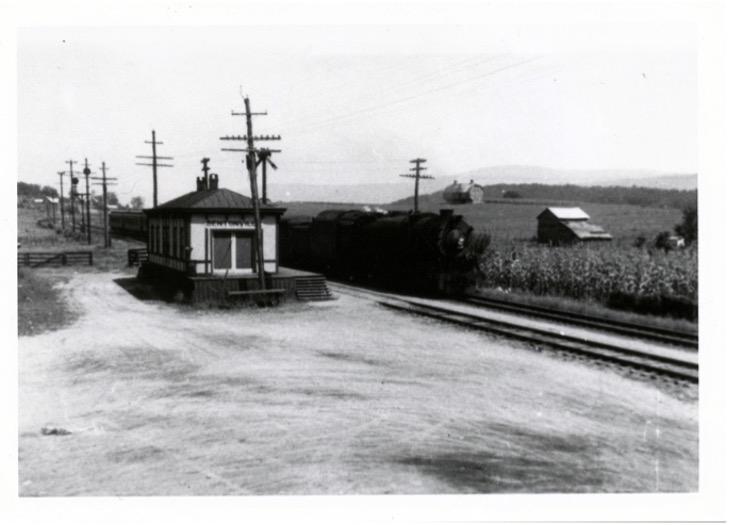
This photo of the Bentonville railroad station was taken in 1938. It would be demolished and a new one built in its place sometime before 1948. There are several interesting things to note. Firstly, the station building seems to be the same one as in 1917; secondly, steam trains were still in use; and thirdly, there is little evidence of people, activity or equipment near the station – suggesting, that only a few trains stopped there regularly, to load or unload freight.
In 1946 all passenger train service to and from Front Royal came to an end but combination passenger and freight trains continued to operate on the track running thru Bentonville from Shenandoah to Hagerstown and some of these would stop in Bentonville.
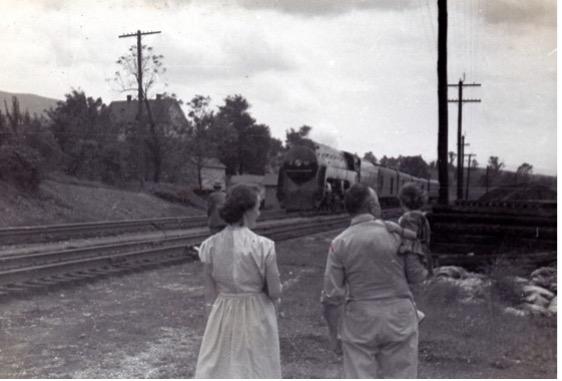
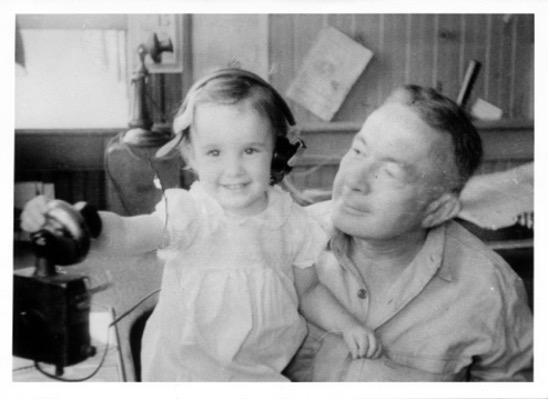
These two photos were taken in 1949. The location of the one on the left is the Rileyville railroad station, just south of Bentonville. As in the 1938 photo, you can see that steam trains were still in use. The people in the photo on the left are Anne Brown Boyd (Earle), aged 2, and her grandfather, Shirley Chilton Weaver, and mother, Justine Weaver Boyd. In the photo on the right Anne is sitting on her grandfather’s knee inside the Bentonville station master’s office.
Shirley Weaver was the station master in Bentonville for quite a few years. His father (Robert Weaver) and both of his brothers, Wilbur and Robert, also worked for N&W RR. This was not uncommon— there were quite a few “railroad families”.
A job on the railroad was seen as a job-for-life and a reliable source of income, especially during times of economic stress such as the great depression. The N&W RR earned a reputation for being a good employer, providing a hard but good life – you could stay at the same company for 50 years. Those men who worked on laying or repairing the tracks or on coupling and uncoupling cars and coaches led dangerous lives and their injury and death rate was amongst the highest in any industry.
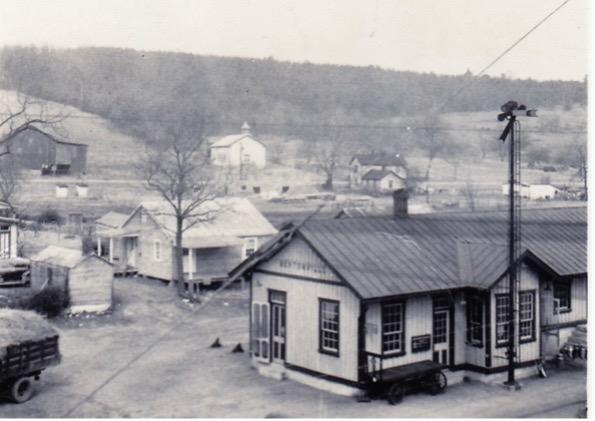
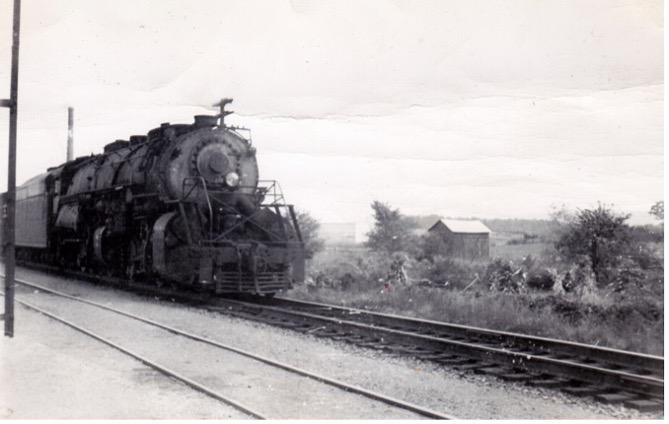
The photos above are also from the late 1940s and early 1950s. Both were taken in Bentonville. In the photo on the left you can see that the original railroad station building has been replaced, although the new building appears to be about the same size as the original building
1956
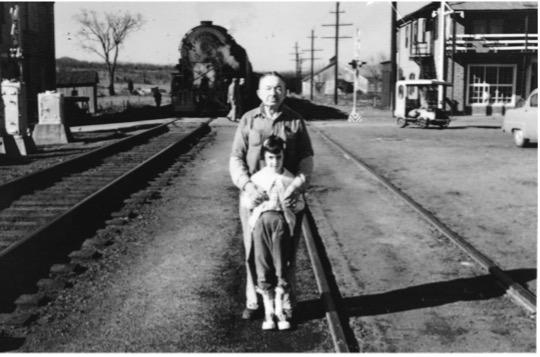
Photo of Anne Brown Boyd (Earle) and her grandfather, Shirley Weaver, in about 1956, just prior to the steam engines being replaced by diesel on the N&W. You can see Johnny Guy’s Cash Store in the background on the right. The store had a great reputation with local kids for its ice cream cones and bottles of pop.
1957-58: The end of Steam
Warren Sentinel, April 1957:
“The steam engine, the old “iron horse” has passed quietly from the local scene.”
While initially a strong proponent of steam, the N&W eventually embraced dieselization, completing the transition in 1958. Diesel engines were undoubtedly more efficient – and railroads such as the N&W, faced with ever mounting competition from trucks, planes, buses and cars, had to adopt it to keep the wolf away from the door.
1965: No Longer a station – simply a “Depot”
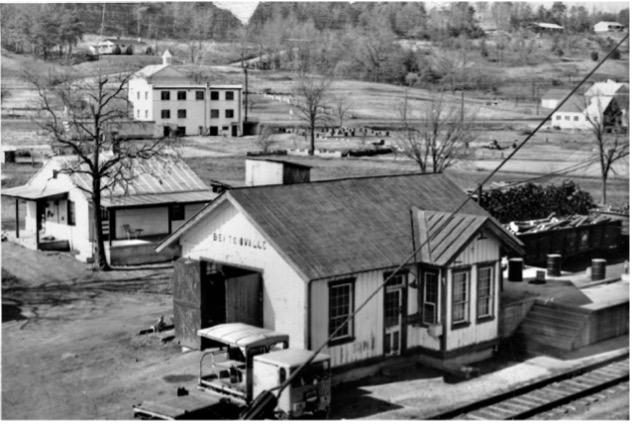
1965 photo of the N & W Depot – the north part of the 1950s passenger station having been removed. Despite this major change, it was still possible for people to board a train at Bentonville.
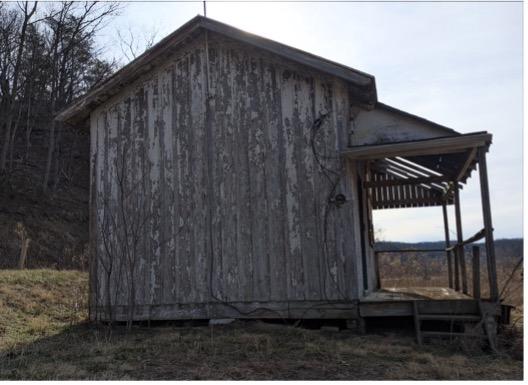
N.B. The part of the building that was removed was actually relocated and repurposed. It exists to this day near the river in Raymond “Andy” Guest Shenandoah River State Park (see photo on right)
1971-1973
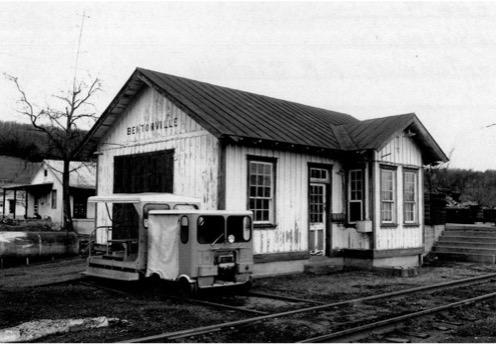
In 1971 the N&W finally stopped offering passenger service on all of its trains.
This 1971 photo was included in a Historic District Survey conducted that year. In the survey report the depot was described as “in need of minor repairs”.
By 1973 the Zollman Flour and grain/feed mill that used to be located next to the railroad depot had gone and only the silos remain. (The mill was originally built and operated by Updikes in 1902-1903).
FINAL CHAPTER
Another Historic District Survey of Bentonville was conducted in 1991. The survey report included no photos of the Bentonville railroad depot and stated simply “Station Destroyed since last survey in 1971.”
If you visit the location today (i.e. 2025) you will see that the station’s raised concrete platform is still there.
———————————————————
ADDENDUM
Anne Brown Boyd Earle has provided us with some more great memories and comments (below) that we would like to add to this article:
Anne recalls farmers bringing large cans of milk and cream to be taken by the trains to the creamery in Hagerstown. In the 1940s-1960s the trains carried tankers of liquified sulfur from the Stauffer Plant in Bentonville to the Viscose (later Avtex) Rayon plant in Front Royal. The trains switched a lot of cars around at the Bentonville stop, which included cars carrying trees that would be taken to the mills.
Messages for the conductor were strapped to a wooden hook (one type looked like a large
“Y”, the other was a circle with a clip on it). At the station the wooden hook would be held up high for the engineer to lean out the window of the cab and snag with his arm. He would then take the message and drop the hook farther down the track to be retrieved after the train passed. Other ways of communicating with the trains included the telegraph, a linked “phone” system with a headset and a button one had to push to talk; and levers inside the station that were set in various configurations to engage metal flags on top of the station.
When passengers traveled on the trains, there was a waiting room at the front of the station off of the parking lot. Anne remembers riding by herself at about age 6 or 7 from Bentonville to Front Royal. She later learned that the Conductor was asked to keep watch on her for that trip!
My memories of the Bentonville train station in the 1950s and early 1960s are “magical”. Lots of interesting people came in and out of the station; many different kinds of cargo were delivered; and the station served as the center of activity for the community.