SKYLINE DRIVE OPENS 1938: SOUVENIR AND BOOK SHOP AT NORTH ENTRANCE TO SHENANDOAH NATIONAL PARK “WHERE SKYLINE DRIVE BEGINS”
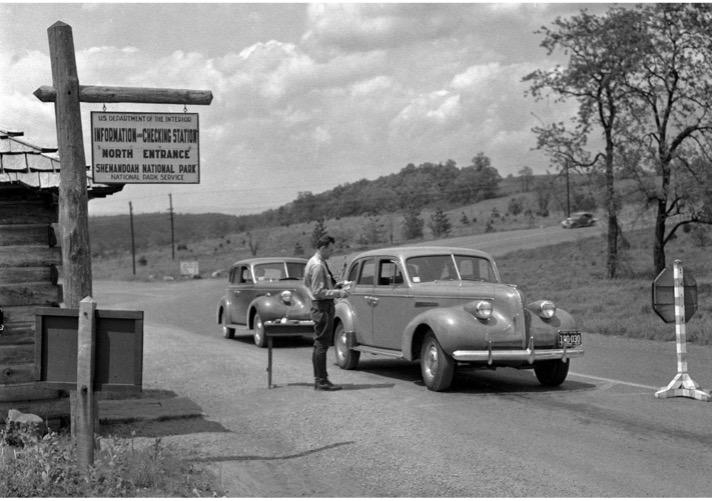
By the time this photo was taken in 1938 the North/Front Royal entrance to the Skyline Drive, Shenandoah National Park, had already been used by thousands of visitors to enter or leave the Park. The first section of the Drive, 34 miles long, opened for travel on September 15, 1934. It extended from Thornton Gap to Swift Run Gap.
The Thornton Gap entrance made available an extensive region of the Blue Ridge in which was located the vast central portion of the proposed Shenandoah National Park. Within a year more than one-half million people visited that portion of the park.
Subsequently the Park Service came under pressure to finish the second link of the Drive from Front Royal to Thornton Gap as quickly as possible. Despite the fact that the permanent service treatment of the roadway was incomplete, cars were sometimes allowed to use the Front Royal entrance before its official opening. In particular, during August 7-9, 1936 a portion of the extreme northern end was opened as a courtesy to Front Royal and its centennial visitors.
The 32-mile stretch from Front Royal to Thornton Gap link was officially opened on October 1, 1936. A local newspaper reported that “There was no formality to the event; no bells were rung; no bands played; no orators celebrated the occasion; no ribbons were cut to permit the movement of a great, spectacular motorcade through the gateway.” Some of the work of surfacing remained incomplete so tourists had to share one lane of travel for a few days until all of this work was finished. On October 2, 1936, the Page News and Courier reported “thousands of tourists have been passing through the historic county seat of Warren County daily en route to or from the beautiful scenic drive.”
Photo showing the first cars entering Skyline Drive through the Front Royal/North entrance to the Shenandoah National Park.
Shenandoah National Park had become part of the National Park System on July 3, 1936
when Virginia transferred its many thousands of acres as a gift to the nation
at a dedication ceremony officially opened by President Roosevelt at Big Meadows,
3,500 feet above sea level, adjacent to Skyline Drive.
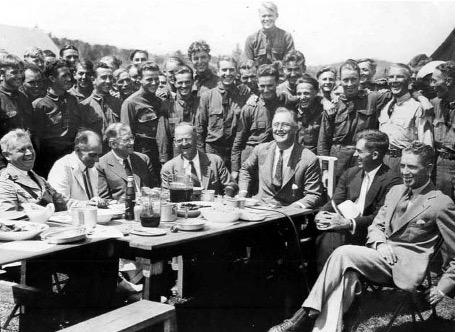
Photo of President Roosevelt, surrounded my members of the Civilian Conservation Corps. (CCC) at the Shenandoah National Park dedication ceremony on July 3, 1936
Shenandoah National Park soon became the most heavily visited park in whole of the National Park System. The highest travel total for a single day occurred September 4, 1938, when 33,681 visitors entered the park in 8,800 automobiles.
| TRAVEL YEARS | PERSONS | AUTOS |
| Oct. 1, 1936-Sept. 30, 1937 | 1,041,204 | 300,974 |
| Oct. 1, 1937-Sept. 30, 1938 | 954,967 | 280,909 |
| Oct. 1, 1938-Sept. 30, 1939 | 911,612 | 270,833 |
WHAT IT WAS LIKE TO TRAVEL ON SKYLINE DRIVE DURING THOSE EARLY YEARS
It took a while for the roads in Front Royal to be updated to cope with the huge increase in traffic brought about as a result of the opening of Skyline Drive. A local politician complained in early 1937 that “between the city limits and the park entrance there is a stretch of road three-tenths of a mile long and so narrow that it reminds one of a country lane. This piece of road would hardly meet the requirements of ordinary travel in a remote rural section and is positively painful to contemplate as an approach to a great national park.”
Once you finally arrived at the northern entrance your car and the number of passengers were noted but there was no entrance charge until 1939 when a daily entrance fee of 25c was introduced, together with a charge of $1 for an annual permit. There were lots of protests at the time about the introduction of these “exorbitant” charges.
Good eating facilities were supplied at frequent intervals by the Virginia Sky-Line Company, the park’s sole concessionaire. Picnickers could find spring water, stone fireplaces and tables at scenic camps established at Dickey Ridge, Sexton Knoll, South River and Elk Wallow Gap.
It was noticed at the various entrance checking stations as early as 1936 that “Negro traffic” was beginning to appear. In 1938 and 1939 the travel amounted to 10,311 and 9,542 persons respectively. Accordingly, facilities were provided for them at an area on Lewis Mountain. Public accommodations there included a picnic ground with 40 tables, 12 fire places, parking areas for 42 automobiles, and a comfort station, while the camp grounds offered facilities for about 30 tents and trailers.
Entertainment was also available at certain stopping places. For instance, it was reported in May, 1937 that “Musicians—fiddlers and banjo players—continue to reap big money harvests each Sunday along the Skyline Drive from tourists. Crescent Rock is a favorite stopping place for the tourists and here the musicians start things going.”
However, driving on Skyline Drive was not without its risks. At the Swift Rim Gap entrance signs advised motorists that they traveled over the mountain road at their own risk. These signs were posted because the section of the road from Big Meadows to Swift Run Gap, a distance of about 20 miles, had not been oil bound and there were many places where drivers might need to look out for loose rocks. Signs all along the drive cautioned motorists not to travel over 30 miles an hour. Snow also caused major problems in the winter. For instance, on the 31st December, 1935 “William E. Carson was found safe In his car Sunday after he had been stalled on the Skyline Drive, near Luray, for more than twenty-six hours. Although he had spent a day and a night in his car in near zero temperatures he apparently suffered no ill effects.”
When drivers did make a mistake, the consequences could be dire. For instance, in June, 1936 it was reported that “Four persons—all over 60 years of age—narrowly escaped death or serious injury when their car plunged 75 feet down the mountainside after colliding with another automobile. But for the shock and minor cuts and bruises, the two couples were none the worse for their experience and continued to Washington as workmen figured how they could bring the wrecked car up the mountainside.”
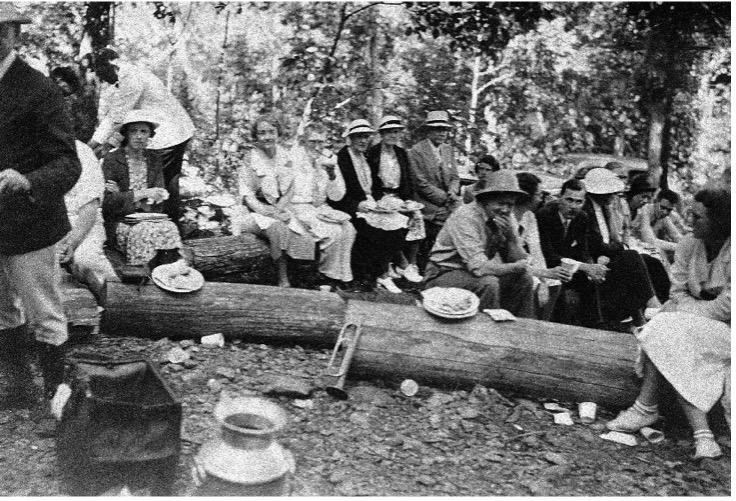
Also notable were the novel ways that some folks made use of the Drive’s facilities for family reunions – such as the Dovel “Clan” reunion in 1936 which involved over 300 clan members.
That same year, as reported in a Page County newspaper, two local politicians, used the Drive as an unusual location for settling a bet about the outcome of an election:
“A novel election bet between Oscar Shifflett and Hamilton Morris, of Green County, was paid by Shifflett on Thursday when he hauled Morris for three miles in a wheelbarrow on the Skyline Drive. Shifflett is a Republican and Morris a Democrat. A week before the election they drew up in writing the stipulations of their wager—that if Roosevelt was reelected Shifflett was to give Morris a wheelbarrow ride of six miles round trip on the Drive, and that if Landon was elected Morris should trundle the wheelbarrow with Shifflett the rider. When the wheelbarrow wager was carried out many of the tourists along the Drive stopped their cars to witness the performance.”
WHICH BRINGS US BACK, FINALLY, TO OUR 1938 PHOTO OF THE SOUVENIR AND BOOKSHOP
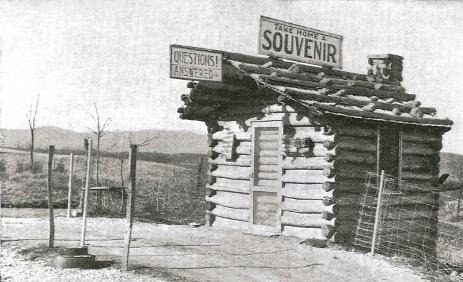
When Skyline Drive was first constructed local timber, especially chestnut, was used in the construction of buildings, instructional kiosks, and signs. These were intentionally built in a “rustic style” that was deemed desirable, given the “unspoilt” natural environment through which the Drive passed and the low cost and easy availability of such timber.
This Souvenir and Bookshop Building near the Front Royal entrance to the Park definitely looks rustic. This, plus its small size, might also have made it appear quite similar to one of the local cabins.
We don’t know much about the history of this shop or the photographer. However, we have discovered a couple of intriguing things which we hope to expand on when we next update this article. In particular, we want to see if we can confirm our hypothesis that the owner of the shop was also the photographer “R.E. Beaty,”—whose name is printed at the bottom of the photo.
Our rationale for thinking that R.E. Beaty may have owned and operated this shop is based on:
- An article in the June 8, 1939 edition of the Warren Sentinel, Front Royal—which includes the following sentence “we were taken with a story as told by Mr. Beatty who operates a souvenir stand near the entrance to Skyline Drive.”
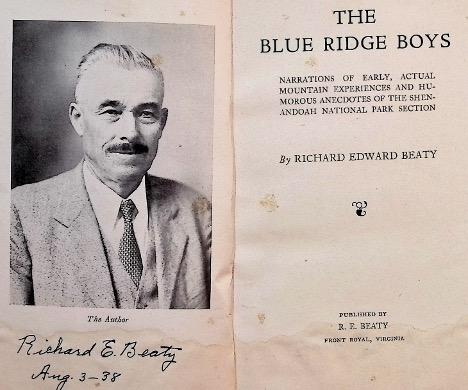
- Research which suggests that R.E. Beaty’s full name was Richard Edward Beaty and that he was the author of several books about the people of the Blue Ridge, including “The Blue Ridge Boys: Narrations of Early, Actual Mountain Experiences and Humorous Anecdotes of The Shenandoah National Park Section” which he published in Front Royal in 1938.